New Zealand Luxury Shifts South
- Real Estate Today - New Zealand

- May 13
- 3 min read
At first glance, New Zealand’s luxury market mirrors its broader property market story. Luxury prices saw a sharp pandemic-era run-up with prices peaking at $2.26 million, a 50 per cent increase from 2019. This was followed by a correction to $1.9 million, a level it has held until prices edged up to $1.93 million most recently. But focusing on the national figure alone obscures what is happening underneath.
At the regional level, Otago has become New Zealand's most expensive luxury market, overtaking Auckland for the first time. While Auckland has hovered around $2.5 million for the past three years, Otago held its pandemic-era gains through the correction and then accelerated, climbing from $2.3 million in 2024 to $2.7 million in 2026. The bulk of that activity is concentrated in the Queenstown-Lakes district and surrounding areas, where constrained supply, lifestyle premium, and growing international demand are combining to push prices higher.
Across regions, the strongest ten-year growth has come from the most affordable luxury markets. Southland ($1.17 million) and West Coast ($950K) have both more than doubled over the decade, likely reflecting buyers priced out of major centres seeking premium lifestyle value at lower entry points.
Auckland tells the opposite story. Despite carrying the second-highest luxury price point in the country at $2.5 million, the region has delivered just 4.4 per cent growth over ten years, including a 2.3 per cent decline in the past year. In real terms, Auckland's luxury market has lost ground over the decade.
Among regions clustered in the $1.3 million to $1.7 million luxury band, annual performance has been uneven. Northland has recorded the strongest gains while Hawke's Bay has seen the sharpest declines.
The national luxury median at $1.93 million, then, is best read as an average of diverging stories rather than a market in its own right — a figure that smooths over the distance between a Queenstown basin running hot and Auckland prestige that has barely moved in a decade. At the suburb level, this divergence becomes more striking.

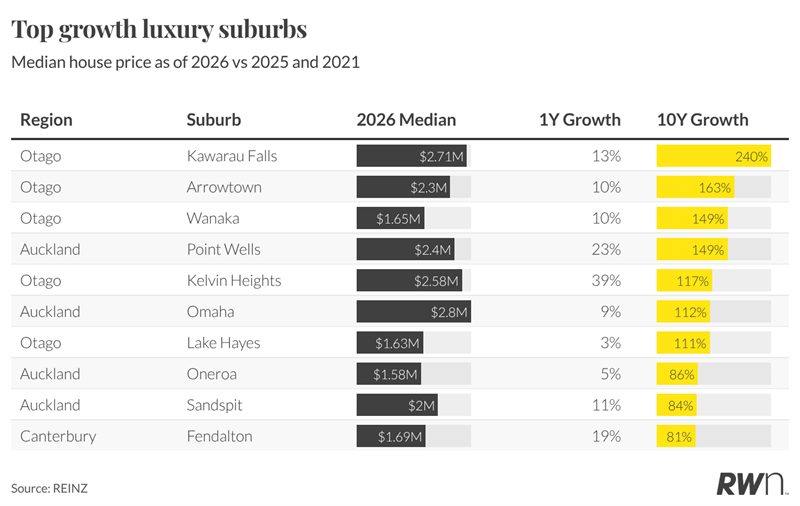
Five of the ten top-growth luxury suburbs are in the Queenstown-Lakes basin, each telling a variation of the same story: scarce, high-amenity land in one of the world's most recognisable resort destinations, with a buyer pool that now extends well beyond New Zealand's borders.
Kawarau Falls leads the list with a $2.71 million median and 240 per cent growth over ten years, with short-term momentum still running at 13 per cent annually. Kelvin Heights, a peninsula suburb with near-uninterrupted lake views, has surged 39 per cent in the past year alone to $2.58 million. Arrowtown, the heritage gold-rush town increasingly favoured by buyers seeking the Queenstown lifestyle at a quieter remove, has grown 163 per cent over the decade with annual momentum of 10 per cent.
In Auckland, Point Wells and Omaha stand apart from a largely flat luxury market. Both are tightly held coastal settlements north of the city with strong lifestyle credentials and limited new supply. Point Wells at $2.4 million has grown 149 per cent over ten years, while Omaha at $2.8 million has doubled over the same period.
Fendalton in Christchurch is the sole Canterbury entry and stands apart from the broader regional pattern. Where most of New Zealand's luxury growth has come from affordable markets, Fendalton is Canterbury's most expensive suburb and its fastest growing. With 81 per cent ten-year growth and 19 per cent annual appreciation, it’s rare for prestige and momentum to point in the same direction.
With foreign buyers once again able to purchase high-value homes under the Active Investor Plus visa, New Zealand's luxury market has a demand tailwind it has lacked for several years. The policy change opens the door to offshore capital at precisely the moment supply in the most desirable locations remains constrained.
Otago and Auckland are best positioned to capture that investment. Queenstown-Lakes offers the combination of global recognition, natural amenity, and limited developable land that draws buyers from well beyond New Zealand's borders. Auckland, despite its subdued recent performance, retains the infrastructure, connectivity, and established prestige suburbs that appeal to offshore purchasers seeking a foothold in the country's largest city.
The broader luxury market is likely to pull in opposite directions from here. Regional prestige markets like Fendalton and the coastal lifestyle pockets of Northland will continue growing, but on domestic demand rather than the external tailwind now opening up for the two major centres. With demand returning to a market that has already demonstrated resilience through a difficult cycle, the conditions for a sustained luxury upswing are stronger now than at any point since the pandemic peak.


Comments